
ILP: Instruction-Level Parallelism
한 번에 몇 개의 instruction이 execute될 수 있는가?
- program마다 다른 거임.
- Average ILP = program 전체의 instruction 수 / PE (processing element)가 무한히 많다고 가정했을 때 필요한 개수
- parallel하게 실행이 가능한 프로그램일수록 값이 커짐
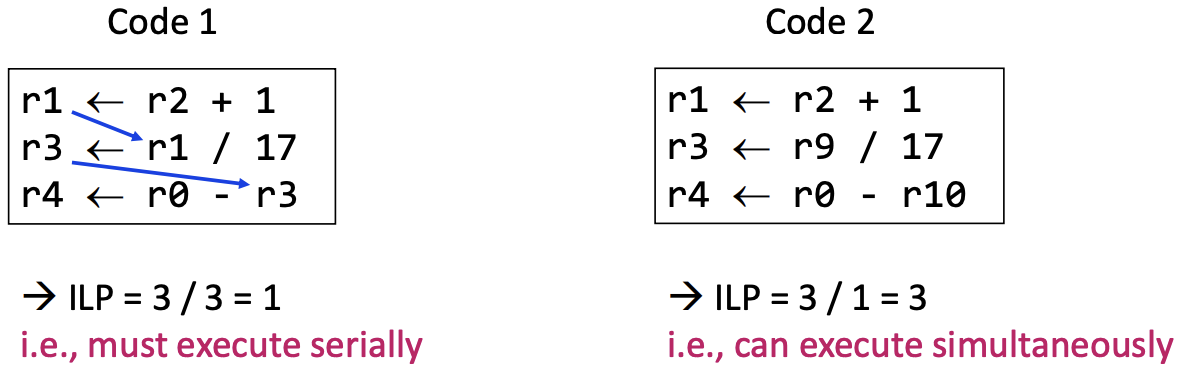
그럼 ILP를 cpu 내에서 어떻게 구현할 수 있을까?
Superpipelined machine
pipeline의 개수를 n개로 늘린다.

Superscalar machine
여러 개의 instruction을 동시에 실행한다.
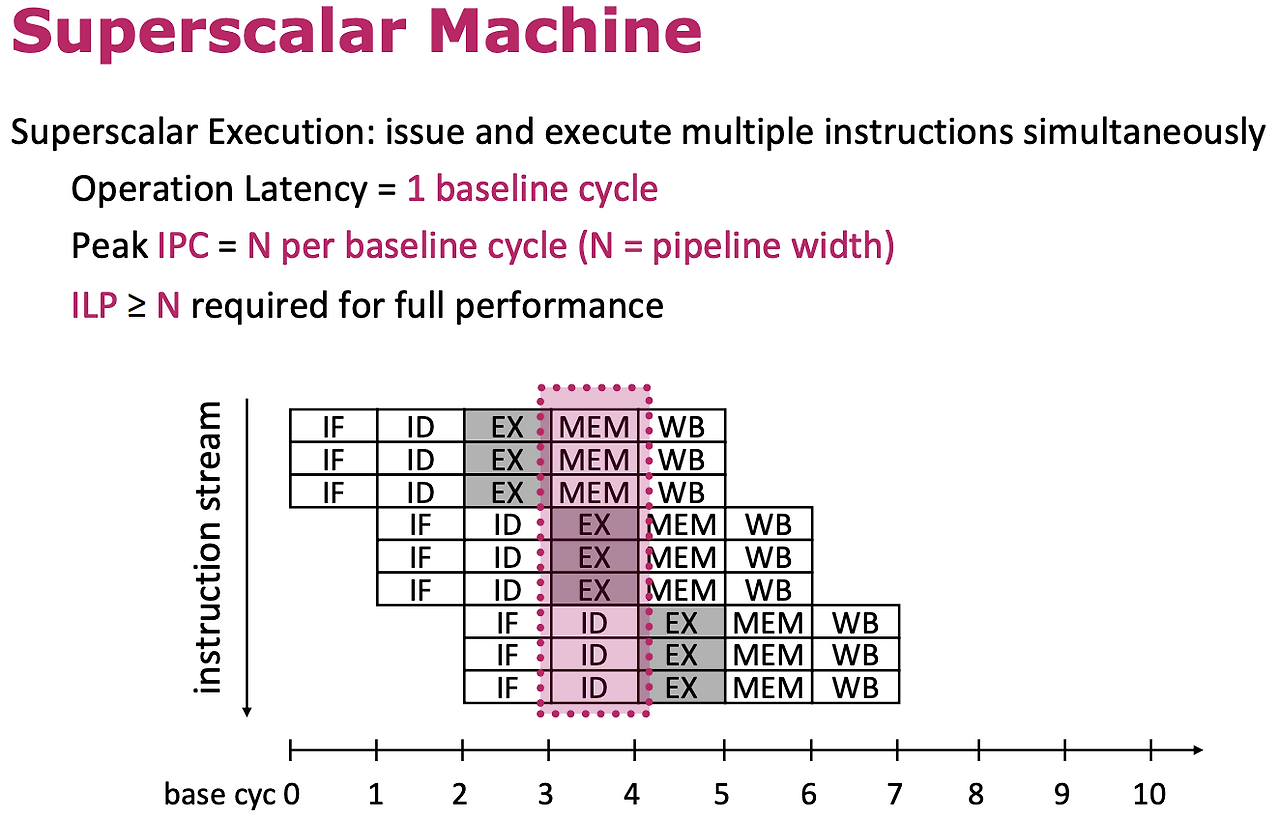
Operation latency
하나의 instruction이 모든 pipeline stage를 통과하는 데 걸리는 시간
Issuing rate (= 이론적인 IPC)
한 Clock cycle당 Instruction이 얼마나 많이 실행될 수 있는가
ex. 4-way superscalar processor: 4 instructions per clock cycle
Superscalar/Superpipelined degree
Superscalar degree: N개의 머신이 패러렐하게 돌고 있다
Superpipelined degree: M개의 스테이지로 파이프라인 되어 있다
Out-of-Order execution
In-order pipeline의 문제점
Instruction 간의 dependency 때문에 parallelism이 일정 수준을 넘어가고 나면 성능이 급격하게 떨어진다. (forwarding으로도 해결이 안 된다)
- ex. N개의 superscalar로 여러 개를 동시에 실행하고 이를 M개로 pipelining했는데, 이게 dependent한 instruction 간의 거리보다 커진다면? 문제가 되겠죠
Register renaming
- 만약 register가 무한히 많았다면 WAR (anti-dependency), WAW(Output dependency) hazard는 발생하지 않는다.
- 왜냐면 register의 이름 때문에 발생하는 거지 data 자체의 true dependency 가 아니기 때문.
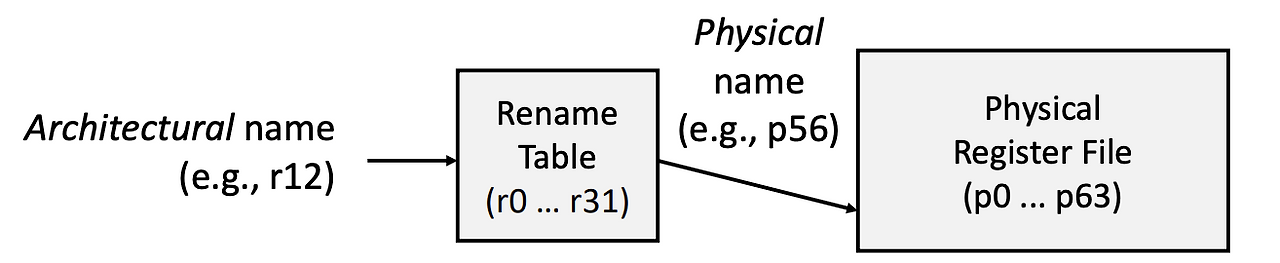
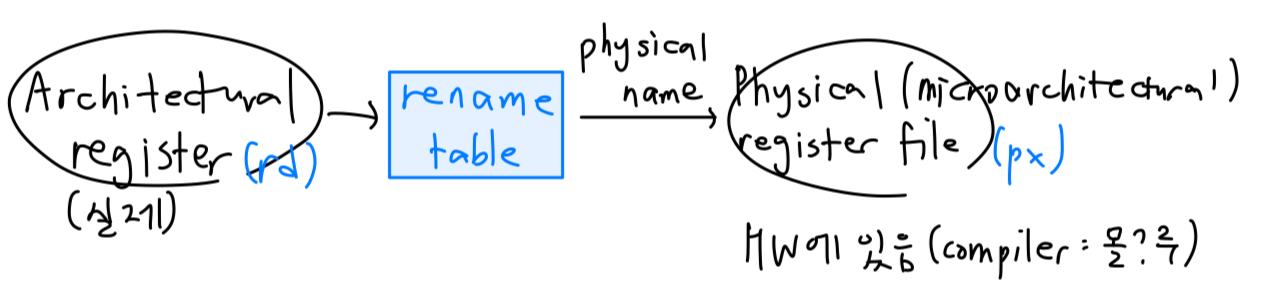
- Renaming table로 architectural register를 physical register로 매핑한다. (이 때 physical register는 CPU 밖에서 보이는 것은 아니다)
- When is it safe to remove a binding (i.e., de-allocate a physical register)
OoO example
- independent한 execution이 순서를 바꿔서 (out-of-order 하게) 실행된다.
- 내부적으로만 순서가 바뀌는 것으로 CPU 밖에서 보이면 안 됨.

OoO의 또 다른 장점: hiding memory latency
Cache miss, 특히 LLC(last-level cache)로 갈수록 cache miss가 나면 많은 instruction을 낭비해야 하는데 OoO로 stall을 해결할 수 있음
Typical Out-of-Order CPU structure

- Fetch→ Decode (→ Register renaming) 까지는 다 in-order
- 여러 개의 Execution Unit으로 issue한다.
그렇다면 Instruction을 어떻게 OoO하게 만들까?
Issue queue (ISQ) or Issue buffer
- Instruction에 있는 모든 operand가 준비되었을 때 issue시킨다.
- 예를 들어 내가 방금 p4←result를 완료했다면,
ROB(register) / LSQ (load-store)
ROB (ReOrder Buffer)
- Programmer’s view에서 instruction은 순서대로 실행해야 하므로, 그 순서 (program order)를 저장해서 순서대로 commit되어 필요한 대로 register 값이 변하도록 해준다.
LSQ (load-store queue)
- memory load-store가 순서대로 commit되도록 해주는 것
- Store
- Load
OoO에서 branch를 잘못 해버린다면? (Speculative Execution)
- (앞에서도 많이 나왔지만) Control flow는 모든 instruction의 대략 14퍼 정도를 차지. 근데 OoO를 하면 잘못된 branch prediction에 대한 페널티가 매우 커짐.
in-order/speculative state , commit/rewind
- In-order state와 Speculative(추측성) state를 각자 보관한 다음에,
- 맞으면 Commit한다.
- Rewind: 넌 틀렸다. speculative state는 마치 없었던 것철머 롤백한다.
Modern OoO mechanisms
이거까지 해야 되나 싶긴 한데
P6-style execution vs R10k-style exectuion
P6-style(Intel Pentium Pro) : ROB가 physical register file까지 포함
R10k-style (MIPS 어쩌고): ROB는 program order만 저장하고 physical register file이 있음
Branch prediction in superscalar CPUs
- Superscalar machine에서 parallel하게 돌고 있는 branch instruction이 2개인데 둘 다 branch하면,
Instruction vs Thread level parallelism (ILP vs TLP)
비유하자면 ILP: 나 혼자서 멀티태스킹, TLP: 알바를 고용함
ILP (Instruction level Parallelism): 여러 개의 instruction을 하나의 thread에서 execute
add r1, r2, r3     # ← can run
mul r4, r5, r6     # ← can run in parallel with add
sub r7, r1, r8     # ← must wait for add to finish
ILP에서 쓰는 것
- Superscalar execution
- Out-of-order execution,
- Pipelining, Register renaming 등
TLP (Thread level Parallelism): 여러 개의 thread, process를 동시에 돌리는 것
Software에 multiple thread가 있어야 함
TLP에서 쓰는 것
- CMP (multicore CPUs)
CMP (Chip-MultiProcessor)
- 여러 개의 simple core를 하나의 chip에 패킹해서 돌린다.
- 서로 독립적인 thread를 parallel하게 돌린다→ TLP (Thread-level parallelism)
- Workload가 parallelize가 가능할 때는 유용하다
- Transistor의 개수는 proportional하게 늘어나지 않고 기하급수적으로 늘어난다. (throughput을 늘리는 데 요구되는 게 많기 때문이다)
Superscalar vs. CMP (여러 개의 simple core)
|
Feature
|
Superscalar CPU
|
CMP (Chip Multiprocessor)
|
|
Definition
|
A single core that can fetch, decode, and execute multiple instructions per cycle
|
A multicore processor with multiple simple cores executing independent threads
|
|
Parallelism Type
|
Instruction-Level Parallelism (ILP)
|
Thread-Level Parallelism (TLP)
|
|
Execution Units
|
1개의 코어당 여러 개의 ALU, FPU가
|
Separate execution units per core
|
|
Pipeline Width
|
넓은 pipeline, 그러나 ILP의 한계로 많이 쓰진 못함
|
좁은 pipeline
|
|
Hardware Complexity
|
Very high: complex issue logic, register renaming, dependency tracking
|
Control logic이 간단함
|
|
Area & Power Cost
|
|
Area, Power 효율이 좋음
|
|
Scalability
|
|
코어 개수만 늘리면 돼서 Scalable
|
|
Branch Prediction
|
|
Predictor가 더 작음
|
|
Use Case
|
Best for single-threaded performance
|
Best for parallel workloads
|
|
Design Tradeoff (Slide 44)
|
e.g., 1 OoO core @ 2GHz
|
e.g., 4 in-order cores @ 1GHz
|
|
Overall Goal
|
per-thread performance를 최대화
|
overall throughput을 최대화
|
직관적으로 이렇게 보면 왜 Pipeline이 더 커도 사용도가 낮은지 알 수 있음.


'cs > csed311' 카테고리의 다른 글
| Virtual memory (0) | 2025.07.07 |
|---|---|
| 13. Memory Hierarchy (0) | 2025.07.07 |
| 11. Exceptions and Interrupt (0) | 2025.04.14 |
| 10. Pipelined CPU - Branch Prediction (0) | 2025.04.14 |
| 7-10 Pipelined CPU / hazards (0) | 2025.04.14 |